COURSE |
|
TEJ4M |
 |
| NAME |
|
Computer Engineering Technology Grade 12, Engineering Focus |
TYPE |
|
University/College |
DATE |
|
2026 09 10 |
DOCUMENTS |
|
Computer Studies, The Ontario Curriculum, Grades 11 and 12, 2008 |
|
|
Growing Success: Assessment, Evaluation and Reporting in Ontario Schools,
2010 |
|
|
|
INSTRUCTOR |
|
C. D'Arcy |
CREDIT |
|
1.0 |
HOURS |
|
110 |
PREREQUISITE |
|
TEJ3M |
MATURITY |
|
5+(0-New course; 5-Established) |
|
OVERVIEW |
|
Computer Engineering Technology courses explore the foundational elements of computing systems such as logic, transistors, and resistors, computing components like CPU's and hard drives, and newer elements of technology that are constantly evolving. Computer technology is an expanding branch of engineering, with roots in both electrical engineering and computer science. It includes the related areas of computer hardware and software; computer interfacing, programming, and networking; analog and digital electronics; and robotics. |
 |
EMPHASIS |
|
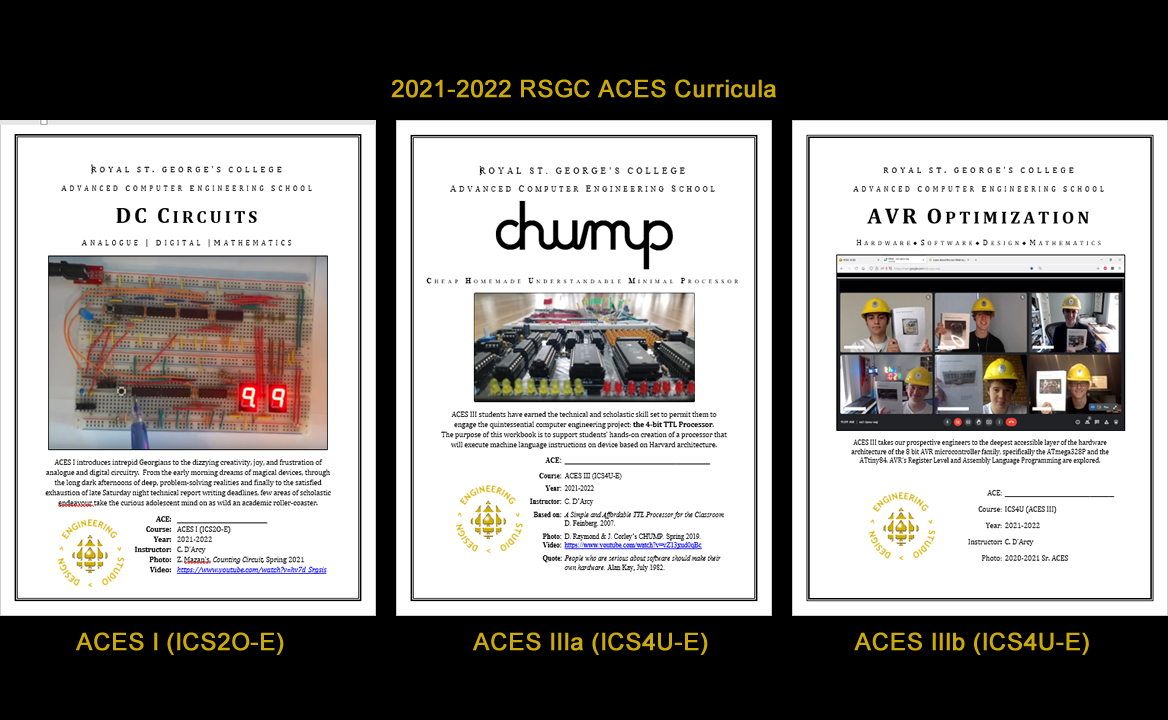
This course focuses on Optimization of AVR 8-bit microcontroller performance |
|
| RESOURCES |
|
CHUMP (Workbook), C. D'Arcy, August, 2026
AVR Optimization (Workbook), C. D'Arcy, August, 2021
Multiple internet resources including datasheets, animations, project logs and AI of course. |
  |
| STRATEGIES |
|
The student is largely responsible for directing his own learning in the context of efficiency and productivity. Whereas the fundamental architecture of AVR microcontrollers, embedded system design, and the ANSI C language are all introduced in class, the assessment and evaluation of student performance will be based almost exclusively on the design and implementation of time-sensitive projects of his own choosing. Upon completion of this course, the student will demonstrate the ability to identify practical problems and projects whose solutions demonstrate the
application of skills and knowledge. |
|
| EVALUATION |
|
New for 2026-27 (Thank Ford)
DER: Common: 25% (Assigned Projects: 4WTL, CHUMP, SAR ADC)
DER: ISP Long: 20% (October-December)
DER: ISP Medium: 20% (January-March)
DER: Culminating Activity: 15% (K-Maps)
Final Exam: 10% (Written-ish )
Attendance and Participation: 10% (Hard not to get perfect on this one)
Categories of Assessment:
Knowledge & Understanding/Thinking, Problem-Solving/Communication/Application |
 |
| STRANDS |
|
Fundamentals: AVR Microcontrollers, Embedded System Design, ANSI C, Sensors, Communication Strategies, and Case/Housing Techniques |
|
| |
|
Skills: soldering, assembly techniques (circuit boards, chassis) |
|
| |
|
Technology, Safety and Society: environmental and health issues |
|
| |
|
Professional Practice and Ethics: Canadian Council of Professional Engineers
Code of Ethics |
|