|
Routine |
Typically some deep thinking required,
but not necessarily a lot of coding. |
|
Hard |
Likely involves either a multiplicity
of (possibly new) concepts or algorithms. Allow time. |
|
Buckle Up |
Start immediately, think
hard, employ a stepwise refinement strategy and post concerns
as required. |
 The Golden Ratio, φ. In class we investigated
the relationship between the sequence defined by the quotients of successive
terms of the Fibonacci sequence
and the Golden Ratio, φ. This can be expressed as,
The Golden Ratio, φ. In class we investigated
the relationship between the sequence defined by the quotients of successive
terms of the Fibonacci sequence
and the Golden Ratio, φ. This can be expressed as,
 |
(GR-1) |
A compelling topic in pure mathematics
is Continued
Fractions. The essential idea is that the deeper the
evaluation of these expressions, the better the approximation is to
the ultimate irrational target, or what we prefer to call it in Calculus, the limit.
The programmatic evaluation of these expressions is a good fit with your understanding
of recursive methods. Here is one example of the continued fraction for the
Golden Ratio.
 |
(GR-2) |
The limit of both of these sequences is φ.
Task. Develop a java project called GoldenRatio,
the output of which will allow the viewer to confirm that both sequences (1)
and (2) converge on φ.
You will maximize your use of recursive methods,
but beyond that, the design of the
classes
and
methods are
yours to
decide based on our efforts last year.
Beyond the
correct answer, my evaluation of your submission will focus on the elements
of good programming: class and method design, efficient implementation,
strong documentation and highly intuitive output. Finally, keep in mind the
following,
- Both strategies incorporate recursion to determine their n'th approximations
to the Golden Ratio.
- The n'th approximation of each strategy are identical (i.e. grFib(1) and
grCF(1) are 1, grFib(2) and grCF(2) are 2, and so on...)
- Recursive methods are elegantly (and deceptively) simple.
 Fibonacci Sequence.
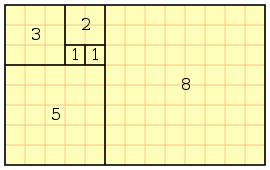 The first two terms of the fibonacci sequence are defined as
t1=t2=1.
All remaining
terms
are defined as the sum of the previous 2 terms.
The first two terms of the fibonacci sequence are defined as
t1=t2=1.
All remaining
terms
are defined as the sum of the previous 2 terms.
- Develop the Java method
public
      int fib (int n)
that
iteratively determines and returns the nth term of the fibonacci
sequence. What is the Big-O of
this implementation?
- Write a piecewise definition of the nth term of the fibonacci
sequence, tn, in a recursive style similar (1) below.
Develop the Java method
public
int fib (int n) that
exercises this definition. What is the Big-O
of this
implementation?
- Is there a way to determine tn in O(1) without using a lookup table?
Powers. It is virtually impossible to provide practical
programming solutions to a variety of complex problems without recursion.
As such, it is an indispensable programming
strategy.
Having said this, you'll have to decide when it's warranted.
Successful implementation of a recursive solution depends on your ability to
define a recursive solution on paper.
For example, the power function, xn can be defined iteratively (non-recursively) as,
xn= x×x×x×...×x (n times)
Defined recursively, we could write,
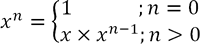 |
(P-1) |
From (1), the implementation is straightforward.
Successful recursive solutions arise from the programmer being able to express
a definition similar to (1) for each new problem, that includes both the
general recursive substitution expression and a basis or stopping
condition.
Tasks.
- Create the project, Powers. Implement the methods described below and supply statements in the main method to test them. Include your suggestion for the Big-O of each algorithm in the comment preceding each method.
- Develop the Java method
public int powerIterative(int x, int n) that
determines and returns the value of xn, iteratively. What is the Big-O of this implementation?
- Develop a second version of
public int powerRecursive(int x,
  int n)
that determines and returns the value of xn, recursively. What is the Big-O of this implementation?
- Develop a third version of
public int pow2(int n) that computes the value of 2n with
a running time of O(1).
- Improved Power Algorithm.
Can the Big-O of the iterative and recursive power algorithms above be improved? Identify a pattern from the following examples,

- Explain this algorithm.
- What is the Big-O of this algorithm?
- Write down the piecewise definition of the algorithm
- Code the algorithm into the method public int powerImproved(int x, int n)
Perfect Powers.
- Develop an inductive expression for perfect cubes, Cn+1, in a manner similar to our in-class development of the formulas for the perfect triangles, Tn+1 and the perfect squares, Sn+1 .
- Looking at the three inductive formulas you have engineered, again, identify the role play by Pascal's Triangle.
- Use this observation to propose and confirm (by example) inductive formulas for perfect fourths and fifths.
- Rewrite your inductive expression for the perfect cubes, Cn+1 in Step 1 as a piecewise recursive function suitable for coding.
Number of Paths. Consider Problem 15 of Project Euler.
- Determine what connection the problem has to Pascal's Triangle.
- Use the conection determined above to solve the problem with pencil and paper.
- Submit your neatly prepared solution to me at the start of class on Monday, Period 1.

